
Impact
What Ebyan is changing in Gode and Harawa
Since Ebyan began in 2025, trained Ebyan Community Champions in Gode Town and Harawa Woreda have opened respectful conversations about FGM/C with households, elders, religious leaders, women’s groups and young people — and families are choosing to keep their girls Ebyan.
Results in Gode · as of 30 September 2026
Every reach target met or exceeded
Ebyan’s first phase in Gode Town (COIN Fund II, June 2025 – April 2027) set targets for awareness, Community Champions and reach. Here is where it stood when field activities closed.
| Indicator | Target | Achieved | Status |
|---|---|---|---|
| Direct beneficiaries (unique people) | 2,900 | 3,971 | Exceeded · 137% |
| Indirect beneficiaries (IEC and outreach) | 18,100 | 18,900 | Exceeded · 104% |
| Total community reach | 21,000 | 22,871 | Reach met |
| Share of direct beneficiaries who are female | ≥ 50% | 58.4% | Achieved |
| Structured dialogue sessions led by Champions | 80 | 97 | Exceeded · 121% |
| Champion knowledge score, pre- vs post-training | ≥ 70% | 35% → 77% | Achieved |
| Community-led initiatives / public declarations | 9 | 6 | 67% · town declaration planned |
| Parents/caregivers who intend not to cut daughters | 6,300 | — | Endline Oct–Nov 2026 |
Unique people reached by kebele: K07 1,165 · K08 1,156 · K13 1,085 · town-level events 824.
Case study · Kebele 07, Gode
A mother’s story: a decision that protects generations
A 27-year-old mother of six in Kebele 07. Like many in Gode, she grew up believing every girl must be cut, and she was preparing to cut her eldest daughter because her school friends were undergoing it.
In Ebyan sessions and neighbourhood dialogues led by the Ebyan Community Champions, religious leaders explained that FGM/C has no basis in Sharia, and health workers described the harm: childbirth complications, infections, long-term pain and trauma. Hearing other mothers who had abandoned the practice changed her mind.
She did not cut her daughter. Today she encourages other women to seek religious and medical advice before deciding — one of a growing number of parents in Gode ready to keep their girls Ebyan.
The full Ebyan case study, fact sheet and progress report are available to partners on request.
Before these sessions, many of us did not fully understand the severe consequences of FGM. The Ebyan Community Champions helped us see that protecting our daughters means rejecting this practice.
A mother of five, Gode
Way forward
Anchoring the change
Field activities in Gode were completed on 30 September 2026. The endline survey, final report and close-out follow in October–November 2026.
The GIZ-funded phase in Gode continues to 30 April 2027 to anchor the results:
- Kebele Ebyan Community Committees with action plans
- Champion follow-up with households already reached
- A town-level joint public declaration
- Joint review and formal handover to the Bureau of Women and Children Affairs
Visible commitment
The Ebyan signboard in Gode Town
A public reminder of the community’s promise to protect every girl.
Be part of the change
Add your name to the Ebyan pledge and help protect every girl in the Somali Region.
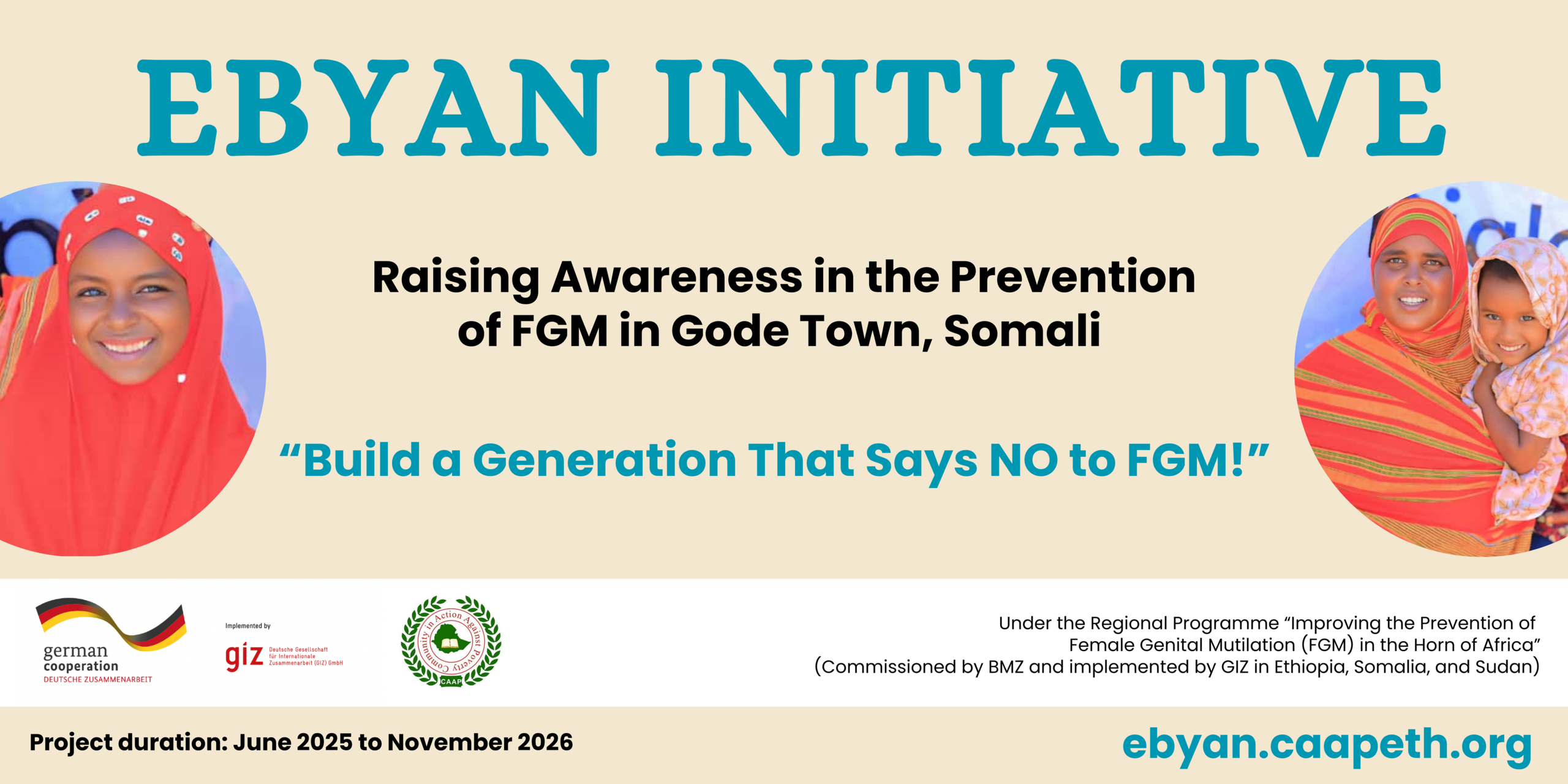
Ebyan is implemented by Community in Action Against Poverty (CAAP). In Gode Town it is funded by GIZ (June 2025 – April 2027) under the regional programme “Improving the Prevention of Female Genital Mutilation (FGM) in the Horn of Africa” (COIN Fund II), commissioned by the German Federal Ministry for Economic Cooperation and Development (BMZ). In Harawa Woreda it is funded by the International Solidarity Foundation (ISF) through the BRAVE project (January 2026 – December 2029). Local partners include the Somali Regional Bureau of Women and Children Affairs, woreda and city women and children affairs offices, religious leaders and elders.